
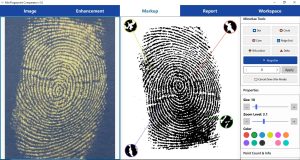
 MAI Fingerprint Comparator: Design and Implementation of a One-to-One (1:1) Fingerprint Comparison System for Forensic Applications
Abstract
Fingerprint identification remains one of the most reliable biometric techniques in forensic science due to its uniqueness and permanence. Despite advances in automated identification systems, forensic experts still rely heavily on manual examination and comparison when making final identification decisions. This paper presents MAI Fingerprint Comparator, a software application designed to support forensic examiners through image enhancement and interactive fingerprint comparison. The system implements traditional image processing techniques to improve fingerprint visualization while preserving image integrity. The software enables investigators to compare fingerprint images efficiently without replacing the expert’s judgment. The proposed system aims to improve examination accuracy, reduce analysis time, and provide a practical digital tool for forensic laboratories.
1. Introduction
Fingerprint analysis has been an essential component of forensic investigations for more than a century. Every individual possesses unique ridge patterns that remain stable throughout life, making fingerprints one of the most reliable forms of biometric identification. Modern forensic laboratories often utilize digital systems to assist fingerprint examiners. However, the final identification process still depends on human expertise. Therefore, software tools should focus on assisting experts by improving image quality and facilitating visual comparison rather than making autonomous identification decisions. MAI Fingerprint Comparator was developed to provide an efficient environment for fingerprint visualization and comparison using traditional image processing methods. The software emphasizes usability, image clarity, and examiner support.
2. Problem Statement
Manual fingerprint comparison may become time-consuming when dealing with low-quality images or large investigation workloads. Existing forensic software may be expensive or overly complex for educationalinstitutions and small laboratories.
The need exists for a lightweight comparison system capable of:
- Image Processing.
- Enhancing fingerprint images.
- Providing interactive comparison.
- Preserving original image quality.
- Assisting forensic experts without replacing human decision-making
3. Objectives
The objectives of MAI Fingerprint Comparator are:
- Improve fingerprint visibility using traditional image enhancement techniques.
- Assist forensic experts in side-by-side fingerprint examination.
- Reduce the time required for manual comparison.
- Maintain image integrity during processing.
- Provide a user-friendly comparison interface.
4. System Architecture
The proposed software consists of four primary modules:
4.1 Image Module
Responsible for importing/processing fingerprint images from supported image formats.
4.2 Image Enhancement Module
This module improves fingerprint visibility using conventional image processing techniques such as:
- Brightness adjustment
- Contrast enhancement
- Noise reduction
- Image sharpening
These operations are applied without modifying the original evidence image.
4.3 Fingerprint Comparison Module
The comparison module allows investigators to inspect two fingerprint images simultaneously. The examiner can visually compare ridge structures, bifurcations, ridge endings, and other identifying characteristics using traditional forensic examination principles.
4.4 Report Module
The documentation unit documents the steps of the forensic examination by displaying the inputs and the operations performed on the inputs and then the outputs.
4.5 Workspace Module
Some cases take a long time to examine, and therefore MAI Comparator provides the ability to save the last point made during the examination to make things easier for the expert.
4.6 User Interface
The graphical interface provides an intuitive workspace where fingerprint images can be viewed, enhanced, and compared interactively.
5. Methodology
The workflow of MAI Fingerprint Comparator follows these steps:
- Import fingerprint images.
- Apply image enhancement.
- Display fingerprints side-by-side.
- Perform visual comparison.
- Examine ridge characteristics.
- Record examiner observations
6. Image Enhancement
Image enhancement improves fingerprint readability without altering the underlying ridge information.
Typical enhancement operations include: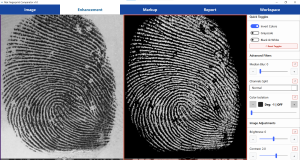
- Contrast enhancement
- Brightness adjustment
- Noise reduction
- Image sharpening
- HSV isolation
These techniques assist examiners in observing fine ridge details, particularly in poor-quality fingerprint images.
7. Fingerprint Comparison
Fingerprint comparison is performed manually by the forensic examiner using the enhanced images.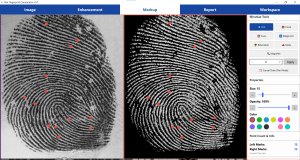
The comparison focuses on:
- Ridge flow
- Ridge endings
- Ridge bifurcations
- Overall fingerprint pattern
The software facilitates examination but does not automatically determine identity.
8. Advantages of the Proposed System
The proposed system offers several advantages:
- Simple and intuitive interface.
- Improved fingerprint visualization.
- Traditional image enhancement techniques.
- Interactive comparison environment.
- Suitable for forensic education and laboratory applications.
- Supports expert-assisted examination.
9. Limitations
Current limitations include:
- No automatic fingerprint matching.
- No minutiae extraction algorithm.
- No AFIS database integration.
- Dependent on examiner expertise.
These limitations are intentional to maintain examiner control over the identification process.
10. Future Work
Future developments may include:
- Automatic minutiae detection.
- Artificial intelligence-assisted comparison.
- Integration with AFIS databases.
- Quality assessment of latent fingerprints.
- Automated report generation.
- Deep learning-based enhancement.
Conclusion
This paper presented MAI Fingerprint Comparator, a software application designed to assist forensic fingerprint examiners through traditional image enhancement and interactive comparison. The proposed system emphasizes image clarity, usability, and examiner support while maintaining the integrity of fingerprint evidence. Rather than replacing forensic experts, the software functions as a decision-support tool that facilitates more efficient and reliable fingerprint examinations. Future work will focus on incorporating intelligent algorithms while preserving the examiner’s central role in the identification process.
References
- David R. Ashbaugh, Quantitative-Qualitative Friction Ridge Analysis.
- Christophe Champod et al., Fingerprints and Other Ridge Skin Impressions.
- Simon A. Cole, Suspect Identities: A History of Fingerprinting and Criminal Identification.
- National Institute of Standards and Technology (NIST), Fingerprint Image Quality and Evaluation.
- ISO/IEC 19794-2: Information Technology — Biometric Data Interchange Formats.
- by: Momen Gamal
- Date: 4/8/2026




No comment